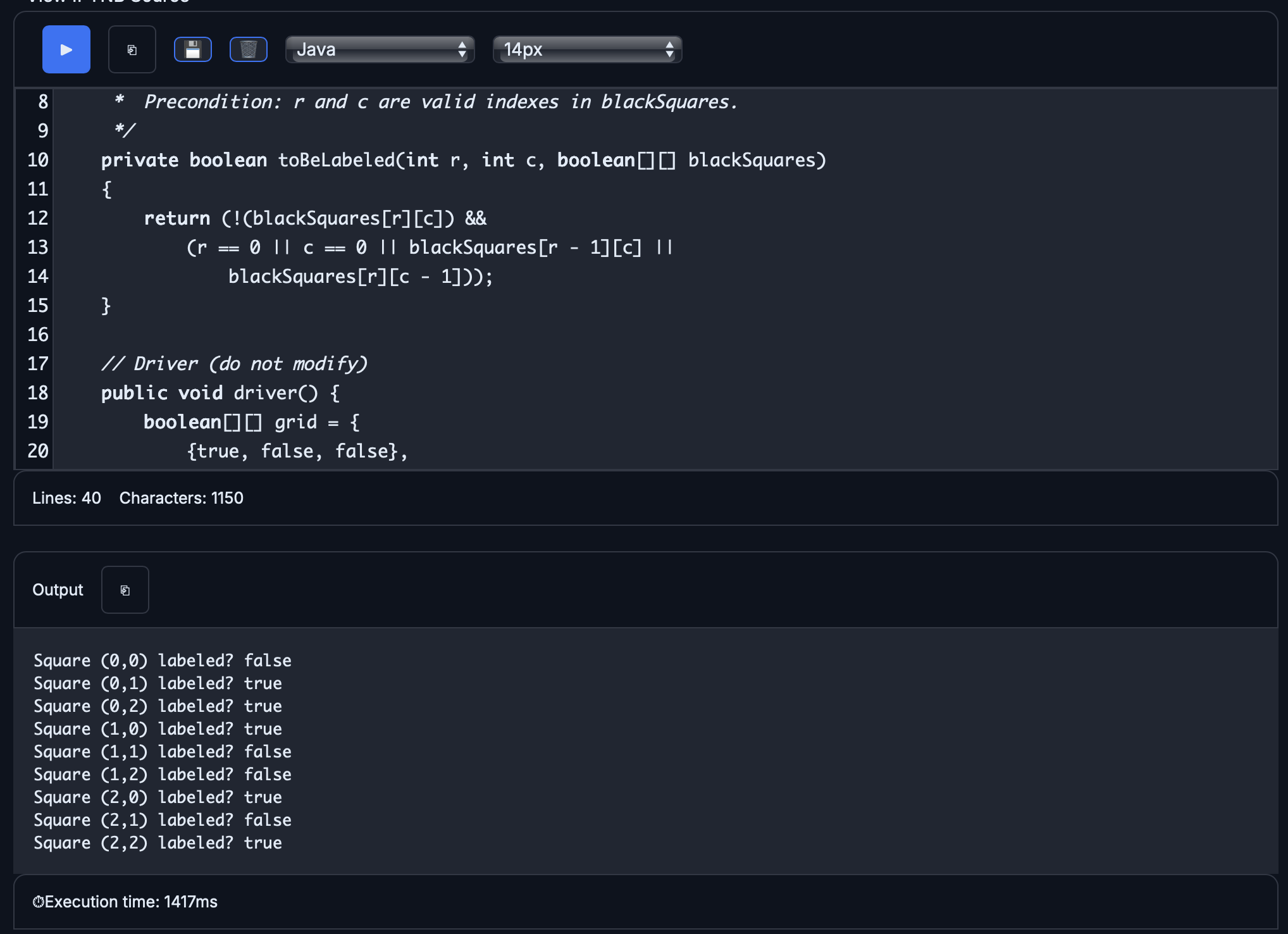
Code:
public class Main {

    /** Returns true if the square at row r, column c should be labeled
     *  with a positive number; false otherwise.
     *  The square at row r, column c is black if and only if
     *  blackSquares[r][c] is true.
     *  Precondition: r and c are valid indexes in blackSquares.
     */
    private boolean toBeLabeled(int r, int c, boolean[][] blackSquares)
    {
        return (!(blackSquares[r][c]) &&
            (r == 0 || c == 0 || blackSquares[r - 1][c] ||
                blackSquares[r][c - 1]));
    }

    // Driver (do not modify)
    public void driver() {
        boolean[][] grid = {
            {true, false, false},
            {false, false, true},
            {false, true, false}
        };

        for (int r = 0; r < grid.length; r++) {
            for (int c = 0; c < grid[0].length; c++) {
                System.out.println(
                    "Square (" + r + "," + c + ") labeled? " +
                    toBeLabeled(r, c, grid)
                );
            }
        }
    }

    public static void main(String[] args) {
        Main tester = new Main();
        tester.driver();
    }
}
Approach
- The method first checks that the square at row r and column c is not black by verifying that blackSquares[r][c] is false.
- It then checks whether the square is located in the first row or first column, since those squares can be labeled if they are not black.
- If the square is not in the first row or column, the method checks whether the square above or the square to the left is black.
- The square should be labeled only when it is white and either on the top/left edge or adjacent to a black square above or to the left.
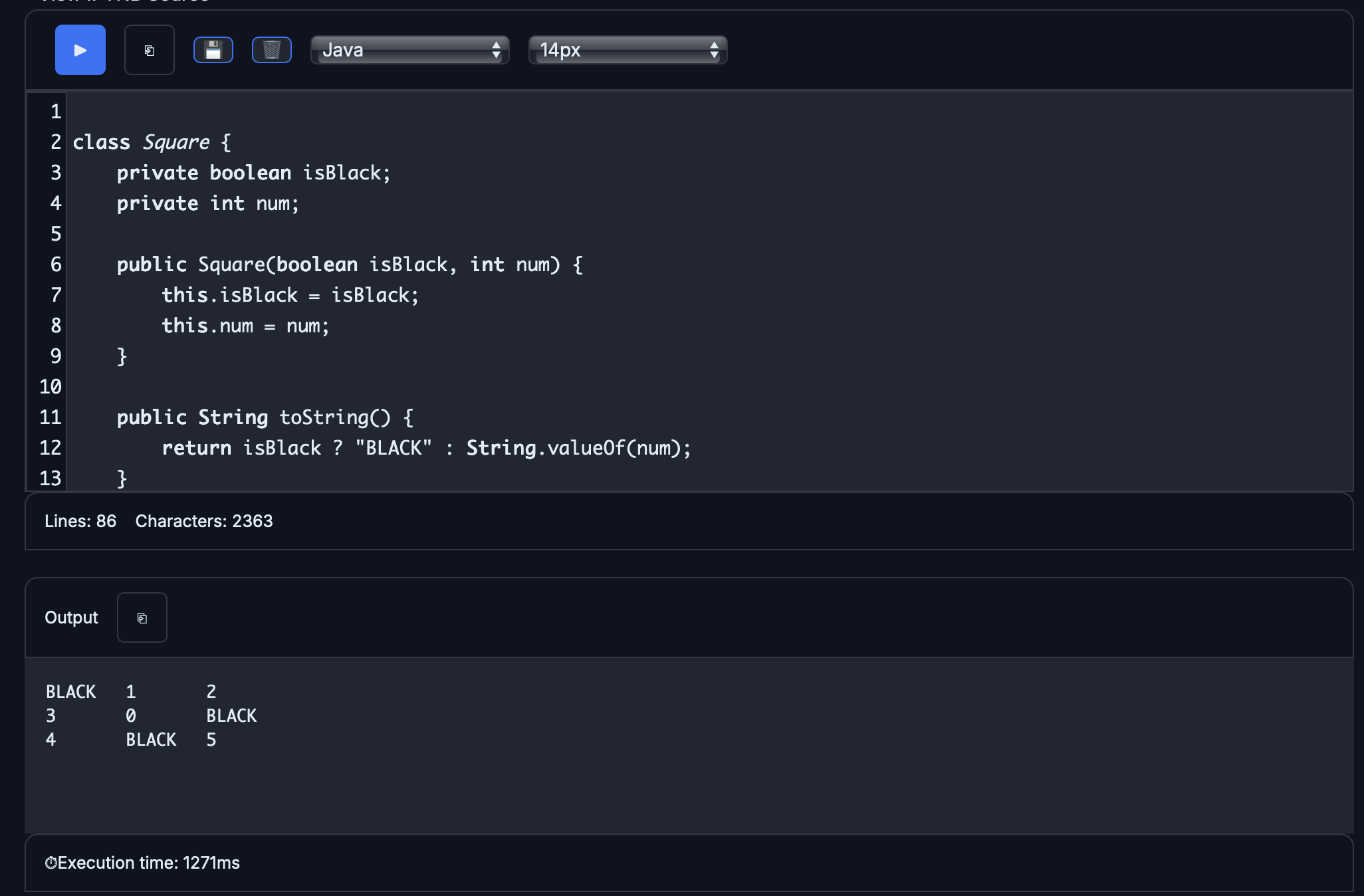
class Square {
    private boolean isBlack;
    private int num;

    public Square(boolean isBlack, int num) {
        this.isBlack = isBlack;
        this.num = num;
    }

    public String toString() {
        return isBlack ? "BLACK" : String.valueOf(num);
    }
}

public class Main {

    private Square[][] puzzle;

    // Assume this method works correctly (given in Part a)
    private boolean toBeLabeled(int r, int c, boolean[][] blackSquares)
    {
        return (!(blackSquares[r][c]) &&
            (r == 0 || c == 0 || blackSquares[r - 1][c] ||
                blackSquares[r][c - 1]));
    }

    /** Constructs a crossword puzzle grid.
     *  Precondition: There is at least one row in blackSquares.
     *  Postcondition:
     *  - The crossword puzzle grid has the same dimensions as blackSquares.
     *  - The Square object at row r, column c is black if and only if
     *    blackSquares[r][c] is true.
     *  - The squares in the puzzle are labeled according to the crossword labeling rule.
     */
    public Main(boolean[][] blackSquares)
    {
        puzzle = new Square[blackSquares.length][blackSquares[0].length];
        int num = 1;

        for (int r = 0; r < blackSquares.length; r++)
        {
            for (int c = 0; c < blackSquares[0].length; c++)
            {
                if (blackSquares[r][c])
                {
                    puzzle[r][c] = new Square(true, 0);
                }
                else
                {
                    if (toBeLabeled(r, c, blackSquares))
                    {
                        puzzle[r][c] = new Square(false, num);
                        num++;
                    }
                    else
                    {
                        puzzle[r][c] = new Square(false, 0);
                    }
                }
            }
        }
    }

    // Driver (do not modify)
    public void driver() {
        for (Square[] row : puzzle) {
            for (Square s : row) {
                System.out.print(s + "\t");
            }
            System.out.println();
        }
    }

    public static void main(String[] args) {
        boolean[][] grid = {
            {true, false, false},
            {false, false, true},
            {false, true, false}
        };

        Main crossword = new Main(grid);
        crossword.driver();
    }
}
Approach
- The constructor creates a puzzle grid with the same number of rows and columns as the given blackSquares array.
- It uses a counter num starting at 1 to assign crossword labels to appropriate squares.
- For each position (r, c), if blackSquares[r][c] is true, it creates a black Square and places it in the puzzle.
- If the square is not black, it calls toBeLabeled(r, c, blackSquares) to decide whether that square should receive a label.
- When a square should be labeled, it stores the current label number and increments it; otherwise, it creates a white square with label 0.