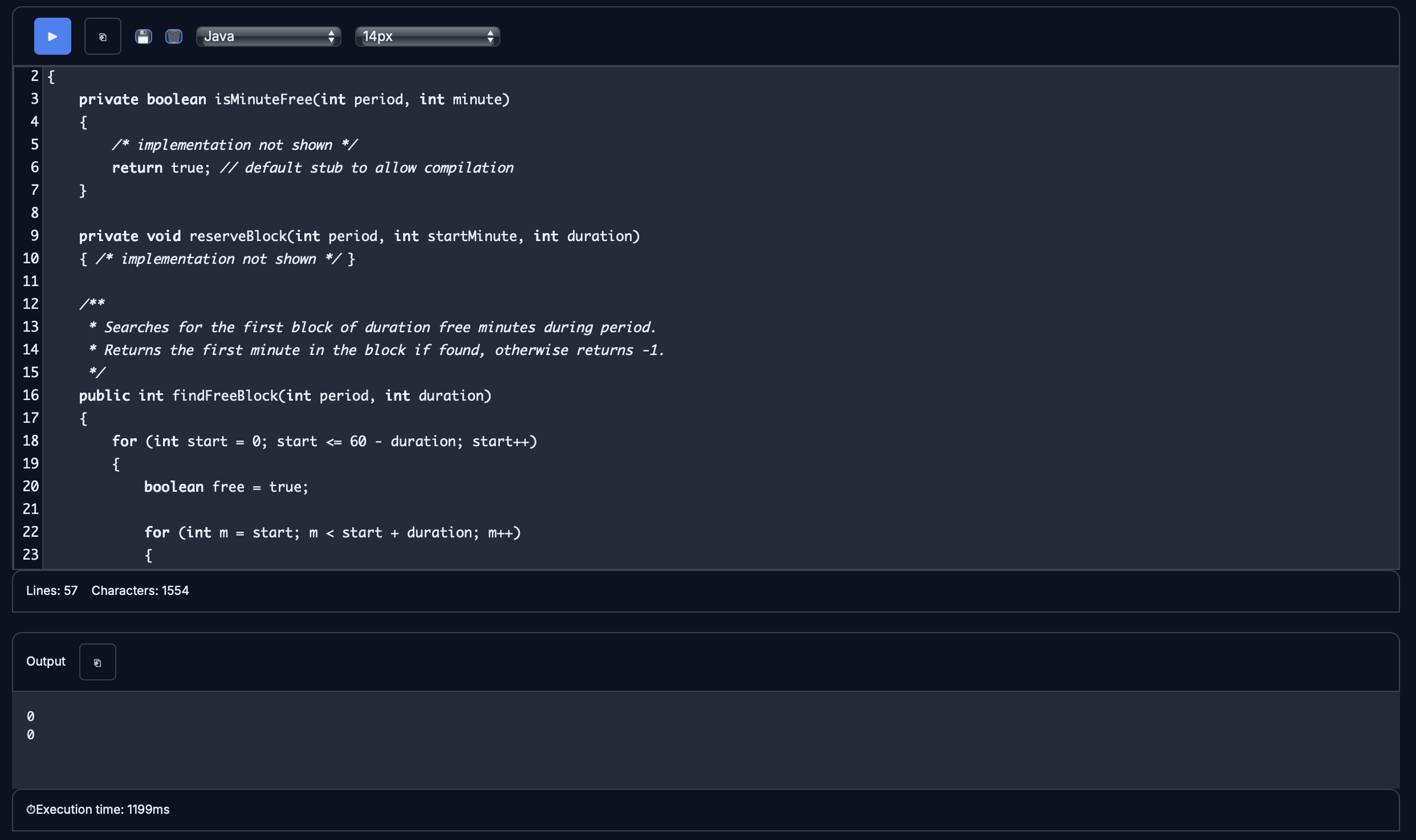
Code:
class AppointmentBook
{
    private boolean isMinuteFree(int period, int minute)
    {
        /* implementation not shown */
        return true; // default stub to allow compilation
    }

    private void reserveBlock(int period, int startMinute, int duration)
    { /* implementation not shown */ }

    /**
     * Searches for the first block of duration free minutes during period.
     * Returns the first minute in the block if found, otherwise returns -1.
     */
    public int findFreeBlock(int period, int duration)
    {
        for (int start = 0; start <= 60 - duration; start++)
        {
            boolean free = true;

            for (int m = start; m < start + duration; m++)
            {
                if (!isMinuteFree(period, m))
                {
                    free = false;
                    break;
                }
            }

            if (free)
            {
                return start;
            }
        }

        return -1;
    }

    public static void main(String[] args)
    {
        AppointmentBook book = new AppointmentBook();

        System.out.println(book.findFreeBlock(1, 10)); // expected 0 with stub
        System.out.println(book.findFreeBlock(2, 30)); // expected 0
        System.out.println(book.findFreeBlock(3, 60)); // expected 0
    }
}

public class Main {
    public static void main(String[] args) {
        AppointmentBook book = new AppointmentBook();

        System.out.println(book.findFreeBlock(1, 15));
        System.out.println(book.findFreeBlock(4, 20));
    }
}
Approach
- Loop through every possible starting minute from
0to60 - durationso the block fits within the 60-minute period. - For each starting minute, check the next
durationminutes usingisMinuteFree(period, minute). - If any minute in the block is not free, stop checking that block and move to the next starting minute.
- If all minutes in the block are free, return the starting minute; if no block works, return
-1.
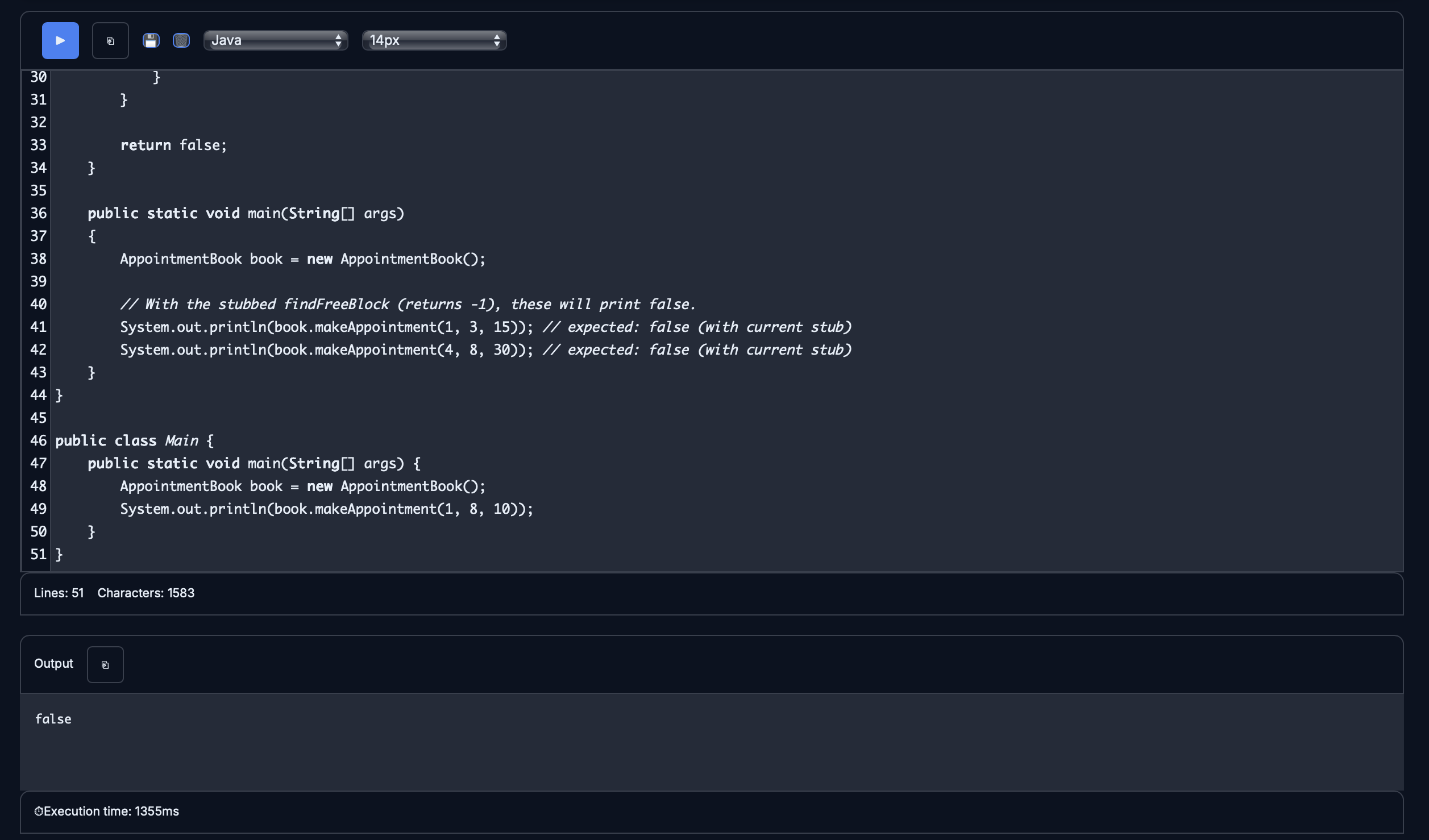
class AppointmentBook
{
    private boolean isMinuteFree(int period, int minute)
    {
        /* implementation not shown */
        return true; // default stub to allow compilation
    }

    private void reserveBlock(int period, int startMinute, int duration)
    { /* implementation not shown */ }

    public int findFreeBlock(int period, int duration)
    { /* assume works correctly */ return -1; }

    /**
     * Searches periods from startPeriod to endPeriod, inclusive, for a block
     * of duration free minutes. If found, reserves it and returns true;
     * otherwise returns false.
     */
    public boolean makeAppointment(int startPeriod, int endPeriod, int duration)
    {
        for (int p = startPeriod; p <= endPeriod; p++)
        {
            int startMinute = findFreeBlock(p, duration);

            if (startMinute != -1)
            {
                reserveBlock(p, startMinute, duration);
                return true;
            }
        }

        return false;
    }

    public static void main(String[] args)
    {
        AppointmentBook book = new AppointmentBook();

        // With the stubbed findFreeBlock (returns -1), these will print false.
        System.out.println(book.makeAppointment(1, 3, 15)); // expected: false (with current stub)
        System.out.println(book.makeAppointment(4, 8, 30)); // expected: false (with current stub)
    }
}

public class Main {
    public static void main(String[] args) {
        AppointmentBook book = new AppointmentBook();
        System.out.println(book.makeAppointment(1, 8, 10));
    }
}
Approach
- Loop through each period from
startPeriodtoendPeriod. - For each period, call
findFreeBlock(period, duration)to see if a valid block exists. - If the method returns a start minute (not
-1), callreserveBlock(period, startMinute, duration)to reserve it. - Return
trueimmediately after reserving; if no period works, returnfalse.